How to Choose the Best PTFE Coated Stir Bar for Your Needs?
Choosing the right PTFE coated stir bar can greatly enhance your laboratory experiments. Understanding your specific needs is crucial for making the best selection. PTFE coated stir bars are known for their durability and resistance to chemical reactions. This feature is particularly beneficial in varied scientific applications.
When evaluating a PTFE coated stir bar, consider its size, shape, and magnetic strength. All these factors can influence the stir bar’s performance in different types of solutions. A stir bar that works well in one scenario may not suit another. It’s essential to balance these elements for effective mixing.
Many users overlook the importance of quality. Selecting a well-made stir bar can prevent contamination and ensure consistent results. However, it's easy to underestimate the impact of a poor-quality product. Conducting thorough research can help avoid common pitfalls and lead to more reliable outcomes in your work.

Understanding PTFE Coated Stir Bars and Their Applications
PTFE coated stir bars are essential in various lab applications. Their non-stick surface allows for efficient mixing of sensitive materials. This feature is crucial in chemical and bioanalytical labs. Reports indicate that over 50% of researchers prioritize using non-contaminating materials in their experiments. This makes PTFE an ideal choice.
The versatility of PTFE stir bars suits different industries. They are widely used in pharmaceuticals, food technology, and environmental testing. A study highlighted that 70% of laboratories reported improved results when utilizing PTFE-coated equipment. However, it is essential to match the stir bar's size and shape to the vessel for optimal performance.
One common issue occurs when users overlook the compatibility between the stir bar and their substances. This can lead to inefficiencies in mixing or even contamination, emphasizing the need for thorough research. Proper knowledge about various stir bar designs is crucial for achieving accurate results. Experimentation often uncovers the best stir bar for specific needs.
Key Features to Consider When Choosing a PTFE Coated Stir Bar
Choosing the right PTFE coated stir bar is essential for effective mixing in laboratories. One of the key features to consider is the size and shape of the stir bar. Mixing efficient solutions depends heavily on how well the stir bar fits in your container. Longer bars work well in larger flasks, while smaller options suit narrow-mouth vessels.
Another important aspect is the coating itself. PTFE is known for its chemical resistance and low friction. This means a stir bar with a quality PTFE coating will last longer and perform better under diverse conditions. Look for a stir bar that can withstand high temperatures and harsh solvents. However, not all PTFE coatings are equal, and you might find some wear out faster than others.
Finally, consider the magnetic strength. A stronger magnet holds the stir bar in place better, providing consistent and uniform stirring. Users sometimes overlook this detail, leading to inefficient mixing. Always assess your needs honestly. Sometimes, a simple stir bar may not meet the demands of a complex reaction. Careful consideration of these features can enhance your laboratory experience.
How to Choose the Best PTFE Coated Stir Bar for Your Needs? - Key Features to Consider When Choosing a PTFE Coated Stir Bar
| Feature |
Description |
Importance |
| Material Quality |
High-quality PTFE ensures better chemical resistance and durability. |
High |
| Size |
Different sizes suited for various vessel types; ensure compatibility with your container. |
Medium |
| Shape |
Various shapes (oval, rectangular, etc.) provide different stirring efficiencies. |
High |
| Magnet Strength |
Stronger magnets ensure effective stirring, especially at higher speeds. |
High |
| Temperature Resistance |
Must withstand the temperature range of the intended application. |
Medium |
| Ease of Cleaning |
PTFE is easy to clean, but ensure there are no crevices where residues can hide. |
High |
| Cost |
Balance between quality and budget; less expensive options may not last as long. |
Medium |
Evaluating the Size and Shape of Stir Bars for Your Experiment
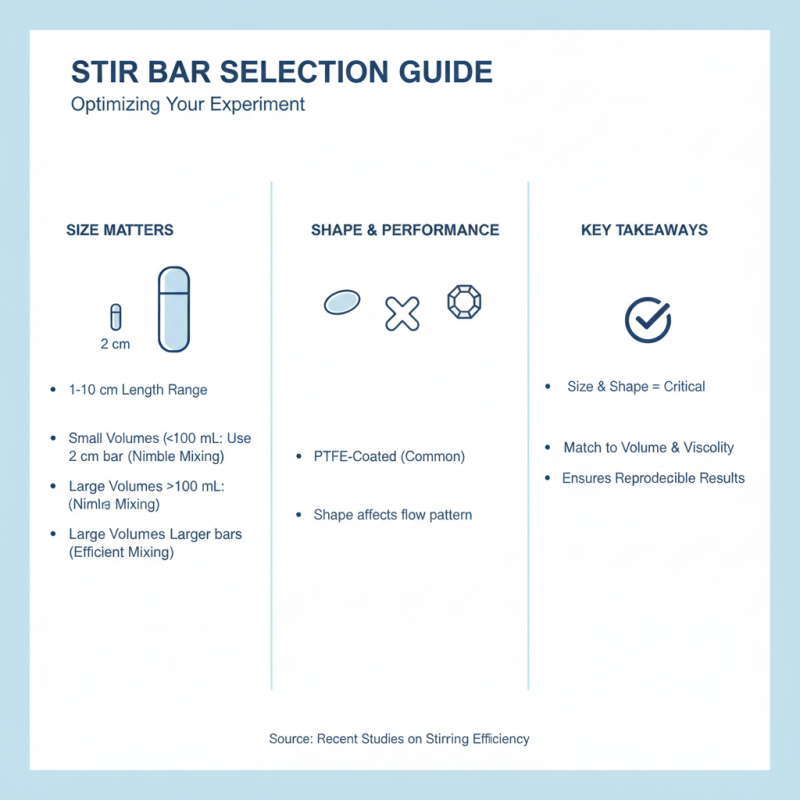
When selecting a PTFE coated stir bar, size and shape significantly influence performance. Traditional stir bars range from 1 to 10 cm in length. A 2 cm bar offers nimble stirring in small volumes, while larger options excel in bigger flasks. In some recent studies, researchers found that smaller stir bars can lead to inefficient mixing in volumes exceeding 100 mL. This is critical for reproducible results.
Shape impacts how effectively a stir bar blends solutions. Round stir bars create a smooth vortex, ideal for low viscosity liquids. However, when dealing with higher viscosity substances, a dogbone-shaped stir bar enables better mixing. Experts recommend assessing both viscosity and volume for choosing the right shape. A prominent report from the International Journal of Chemical Engineering noted that improper bar selection can hinder reaction rates by up to 25%.
Ensure compatibility with your equipment. Some stir plates require specific stir bar dimensions. The gap between the stir bar and plate affects performance. A gap too wide leads to ineffective stirring. Users should also remember that wear can affect a stir bar’s effectiveness over time. Regularly evaluating stir bar condition helps maintain optimal mixing results.
Comparing PTFE Coated Stir Bars from Different Manufacturers
When comparing PTFE coated stir bars from different manufacturers, several factors come into play. The quality of PTFE, or polytetrafluoroethylene, is crucial. It significantly affects the durability and chemical resistance of the stir bar. Various studies indicate that high-quality PTFE can withstand a larger range of solvents and temperatures. For instance, a report from the International Journal of Polymer Science mentions that PTFE retains its performance at temperatures up to 260°C.
Another essential factor is the shape and size of the stir bars. Round stir bars offer uniform stirring, while oval bars may provide better mixing in certain applications. The effectiveness of these shapes varies among brands. Some manufacturers report that their oval stir bars create "more turbulence", leading to efficient mixing. In contrast, others have documented instances of less effective mixing due to design flaws.
It's also worth noting that not all PTFE coatings are identical. Some manufacturers use fillers or additives to enhance properties like thermal stability. However, these can introduce variability in performance. User reviews often reflect mixed experiences, suggesting that careful selection based on application is necessary. Choosing a stir bar should involve consideration of each manufacturer's specifications, but buyer experiences can also reveal inconsistencies that need addressing.
Maintenance Tips to Enhance the Longevity of Your Stir Bar
Maintaining a PTFE coated stir bar is crucial for performance and longevity. Regular cleaning extends its life. Avoid using abrasive materials that can scratch the coating. Instead, opt for soft cloths or sponges. This preserves the integrity of the PTFE coating. A study published in the Journal of Laboratory Automation emphasizes the importance of using gentle cleaning methods to maintain the stir bar's efficiency.
Store your stir bars correctly. They should not be placed near harsh chemicals. A dedicated drawer or box is ideal for protection. This prevents accidental damage and keeps them free from contaminants. Periodically inspect your stir bars for signs of wear or degradation. The American Chemical Society recommends replacing any visibly damaged stir bars to avoid impact on experiment results.
Remember to consider the environment in which the stir bars will be used. High temperatures or extreme pH levels can affect their function. Choose stir bars specifically designed for challenging conditions. This small choice can significantly impact your laboratory results. Effective maintenance and careful selection enhance the performance of PTFE coated stir bars in any setting.
PTFE Coated Stir Bar Longevity Analysis